Someone says they served. Maybe they say a lot more than that: a SEAL Trident, a combat deployment, a Silver Star. You've got doubts. What now?
Short answer: to verify military service, start with the documents the person can share, such as a DD-214. Then request the releasable parts of their Official Military Personnel File from the National Personnel Records Center under FOIA. Compare what the record says with what the person claims, and remember that gaps in a record are common and aren't proof of a lie.
This guide walks through that process the way we try to do it at Trident For Truth: carefully, with the records in hand, and with respect for the people who actually earned what they wear.
What does a DD-214 show, and what doesn't it show?
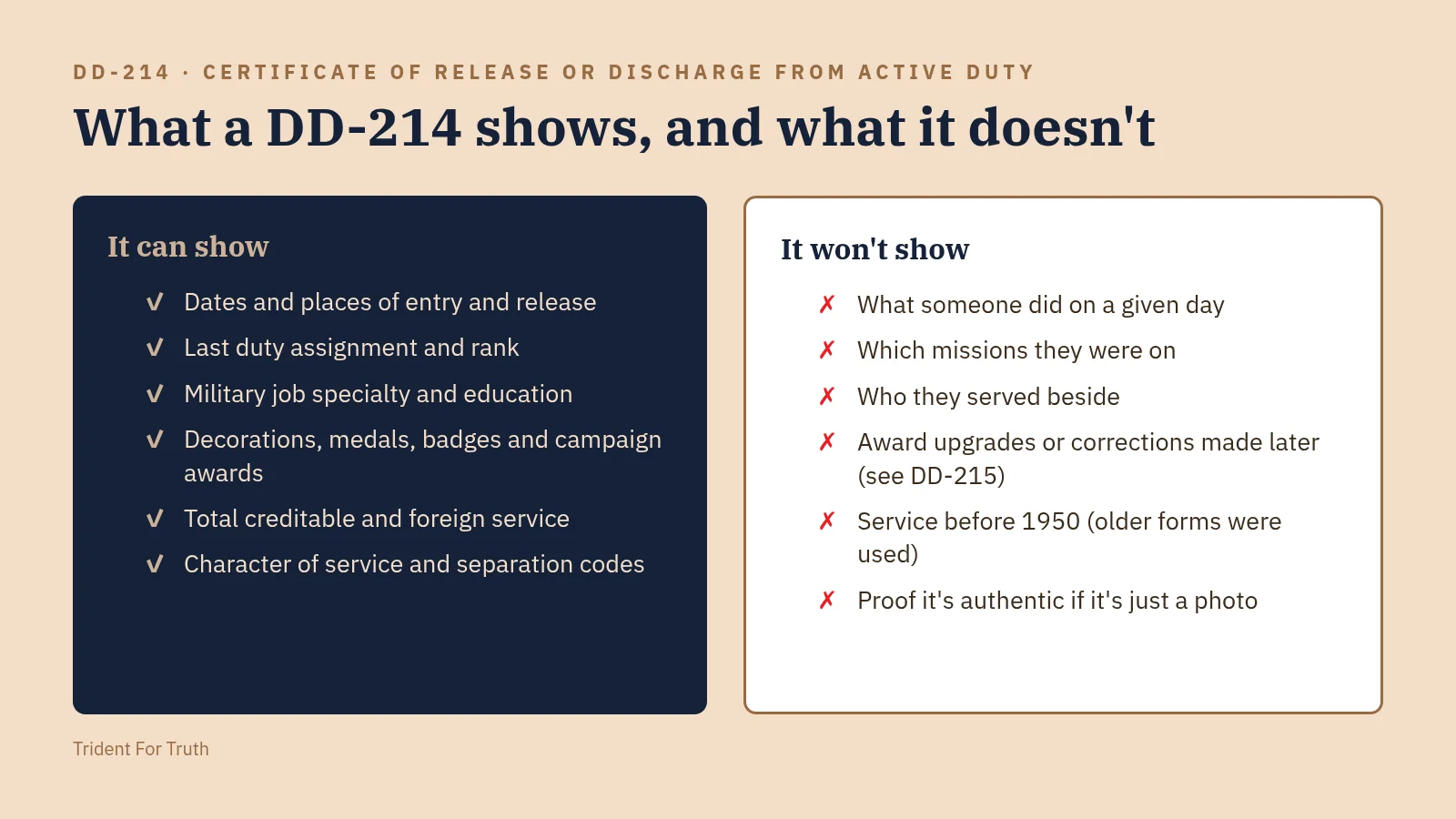
A DD-214 is the closest thing to a service summary most veterans have. According to the National Archives, a report of separation is generally issued when a service member completes active duty or at least 90 consecutive days of active duty training. It can show:
- dates and places of entry into and release from active duty
- last duty assignment and rank
- military job specialty and military education
- decorations, medals, badges, citations and campaign awards
- total creditable service and foreign service credited
- separation details, including character of service and reenlistment codes
That's a lot. But it isn't everything.
A DD-214 won't tell you what someone did on a given day, which missions they were on, or who they served beside. It reflects what was entered at separation, so later award upgrades or corrections may live in other documents. Records issued before January 1, 1950 used different forms entirely (the WD AGO 53-55 and NAVPERS 553 are two examples). And a person who served only in the Reserve or Guard without qualifying active duty may never have received one.
So a DD-214 is strong evidence. It's also a starting point, not a verdict. A photo of one sent over text is weaker still, since a picture of a document is easy to alter. If something on it looks off, the official file is where you go next.
New investigations and episodes in your inbox.
How do you request records from the National Personnel Records Center?
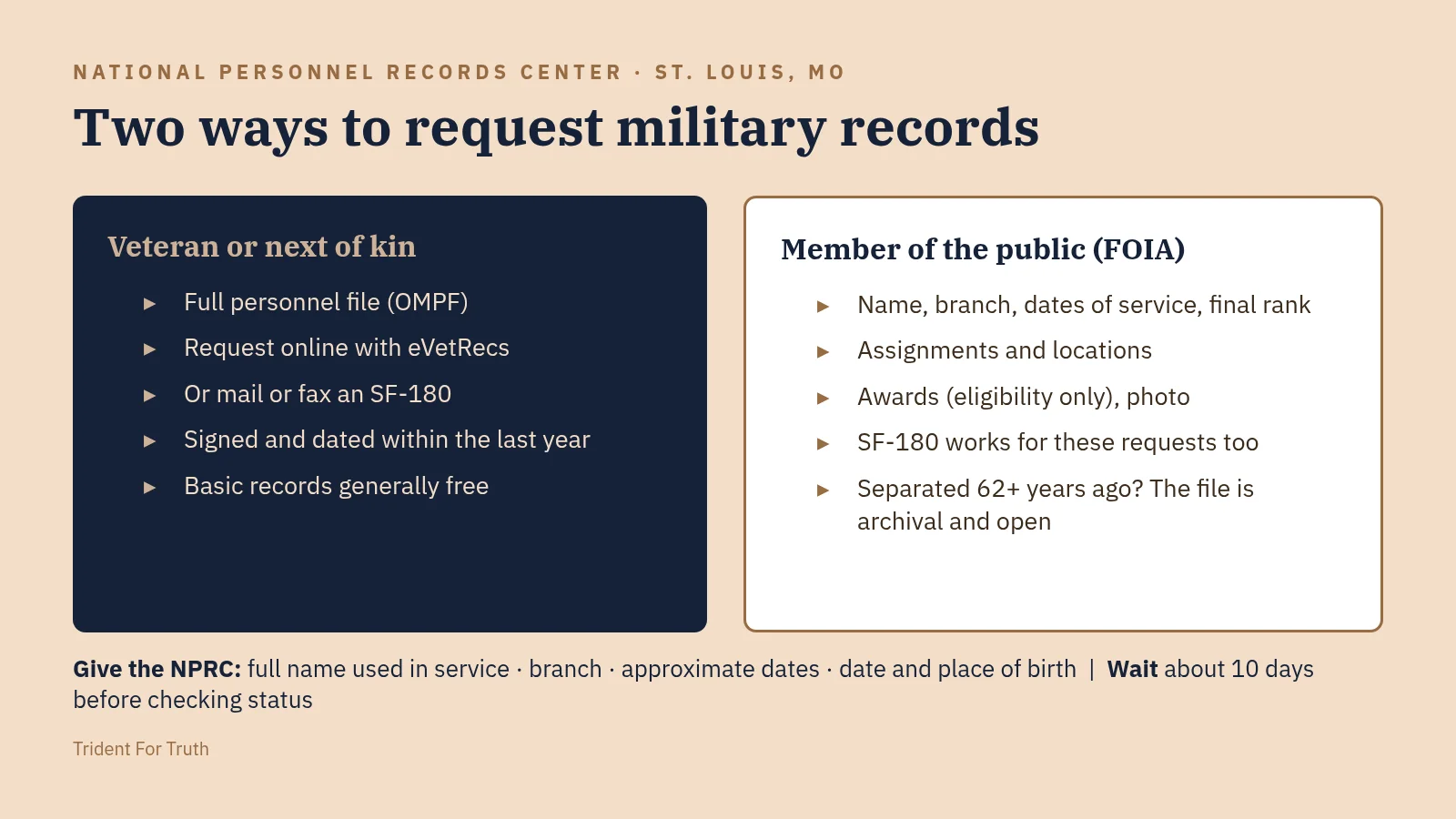
The National Personnel Records Center (NPRC) in St. Louis holds Official Military Personnel Files (OMPFs) for millions of former service members. How much you can get depends on who you are.
If you're the veteran or next of kin, you can request the full file through eVetRecs online, or by mailing or faxing a Standard Form 180. The NPRC says the SF-180 isn't mandatory but is the recommended method, and requests must be signed and dated within the last year (NPRC access rules). Basic records are generally free for veterans and next of kin.
If you're a member of the public, you're working under the Freedom of Information Act. The NPRC's FOIA page lists what can usually be released without the veteran's consent, including:
- name, service number and branch
- dates of service and final rank
- assignments and geographical locations
- military education level
- awards and decorations (eligibility only)
- photograph, place of entrance and separation
- transcripts of courts-martial trials
The SF-180 works for these requests too. Give the NPRC as much identifying detail as you can: full name as used in service, branch, approximate dates, and date and place of birth. Without enough detail, they can't find the file.
Older records open up further. Files of veterans who separated 62 or more years ago become archival and are open to the general public (archival OMPF requests). And if you only need to know whether someone is on active duty right now, the Department of Defense's SCRA website can confirm current status (it's built for creditors and courts, and you'll need identifying details like a date of birth).
Expect to wait. The NPRC says response times depend on the request's complexity, record availability and its workload, and suggests allowing about 10 days before even checking status.
What are the limits of public records?
Here's where a lot of online "investigations" go wrong. They treat a FOIA response as the whole story.
It isn't. The public release leaves out a great deal by design. The Privacy Act protects personal details, and award information comes back as eligibility, not a narrative of what happened. Assignments may be listed by unit and location with no detail about duties.
Special operations make this harder. Unit names in a file can be generic. Some assignments simply won't be spelled out in a public response. That cuts both ways: it gives cover to real operators who can't talk about their work, and it gives room to people who want to hide behind "it's classified."
The fair approach is to compare specific, checkable claims (branch, dates, rank, schools, awards) and not to demand proof of things no public record would ever show.
Why isn't a missing record proof of fraud?
Because records go missing for real reasons. The biggest one has a date.
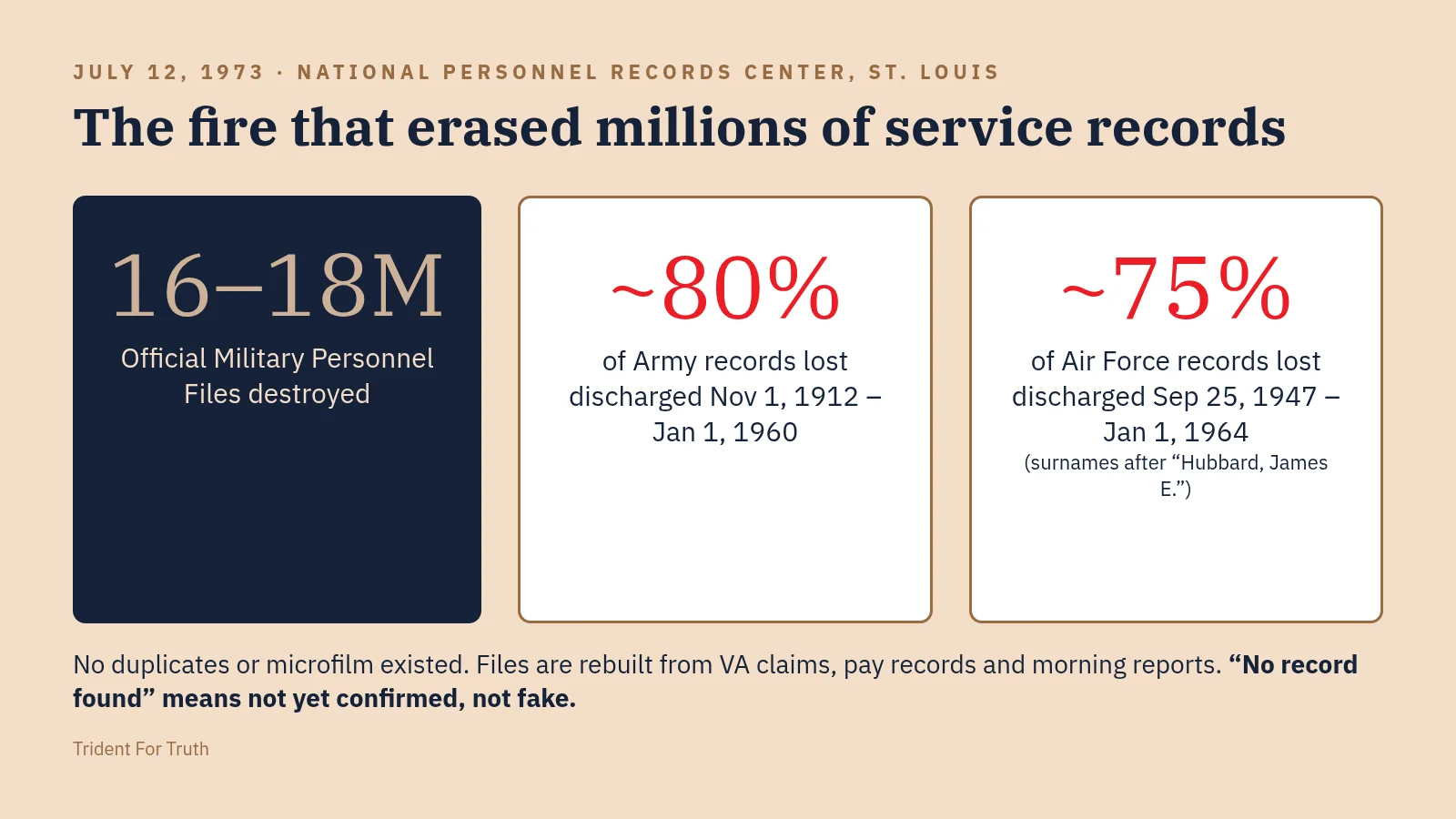
On July 12, 1973, a fire at the NPRC destroyed an estimated 16 to 18 million personnel files, according to the National Archives. About 80% of Army records for personnel discharged from November 1, 1912 to January 1, 1960 were lost. So were about 75% of Air Force records for those discharged from September 25, 1947 to January 1, 1964, with surnames alphabetically after Hubbard, James E. No duplicates or microfilm copies existed.
The NPRC has spent decades rebuilding files from other sources, such as VA claims files, pay records and morning reports. Those reconstructions take time, and some are incomplete.
Then there's ordinary error. Names get misspelled. Service numbers get transposed. A request with the wrong birth year can come back "no record found" for someone who served twenty years.
So when a search turns up nothing, the honest conclusion is "not yet confirmed." That's a long way from "fake."
What's a red flag, and what's an honest mistake?
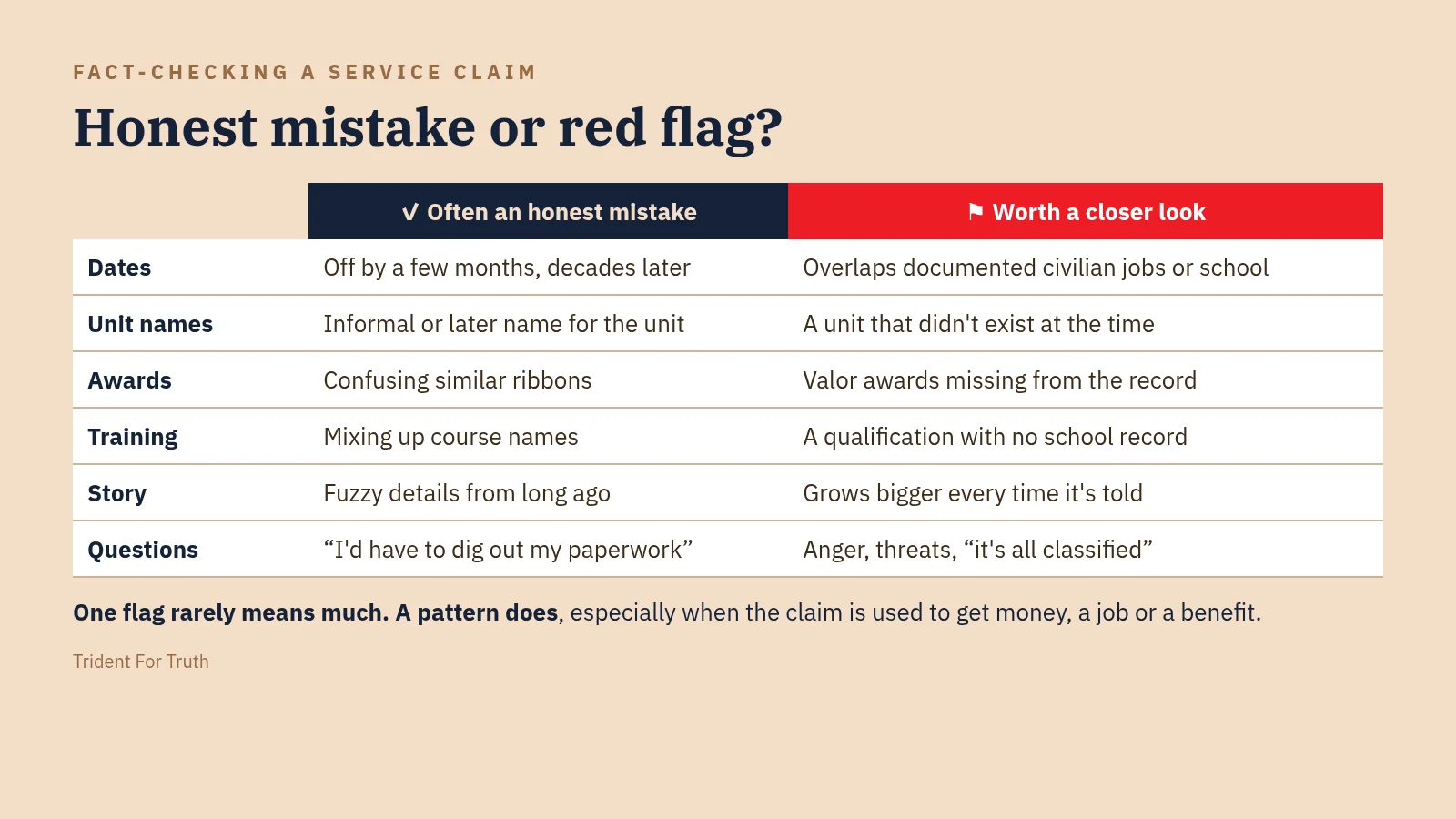
Not every wrong detail is a lie. Memory fades, and people misuse terms all the time. Here's how we tend to sort them.
| Looks like | Often an honest mistake | Worth a closer look | |---|---|---| | Dates | Off by a few months, decades later | Service that overlaps with documented civilian jobs or school | | Unit names | Using an informal or later name for the unit | A unit that didn't exist at the time claimed | | Awards | Confusing similar ribbons or naming a unit award as personal | Valor awards that don't appear anywhere in the record | | Training | Mixing up course names | Claiming a qualification with no school record at all | | Story | Fuzzy details about events long ago | A story that grows bigger every time it's told | | Response to questions | "I'd have to dig out my paperwork" | Anger, threats, or a sudden "it's all classified" |
One flag rarely means much. A pattern does. Pay special attention when a claim is being used to get something: money, a job, a speaking fee, a donation, a discount.
That's also where the law comes in. The Stolen Valor Act of 2013 made it a federal crime to fraudulently claim certain military decorations with the intent to obtain money, property or another tangible benefit. Lying about service to impress someone at a bar is shameful. Lying to collect a benefit can be a crime.
Why should you contact someone privately before going public?
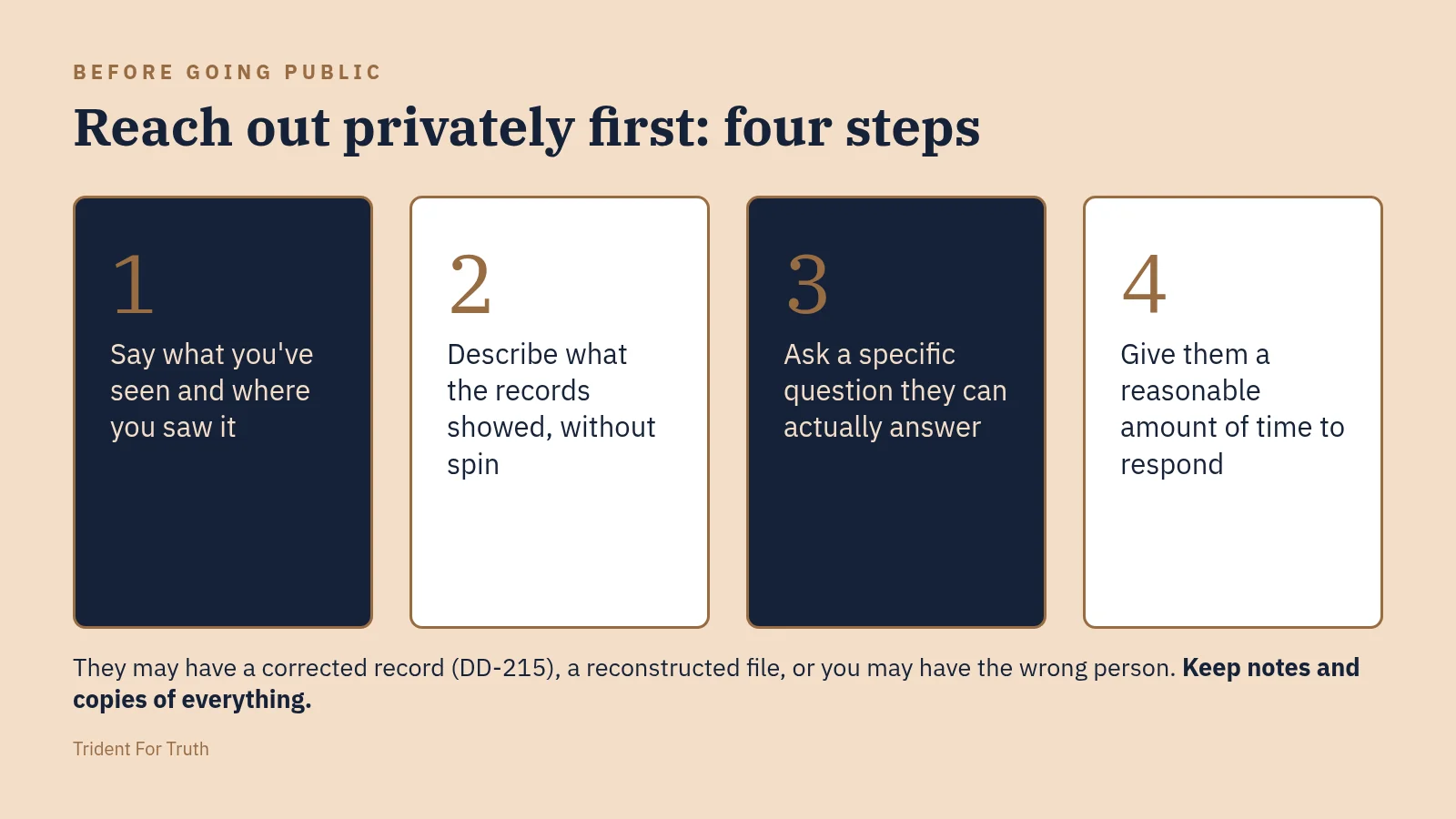
Because you might be wrong. And public accusations don't come with an undo button.
A private message gives the person a chance to clear things up. Maybe they have a corrected DD-214 (a DD-215 is the form used to correct one). Maybe there's a reconstructed file. Or maybe you were looking at the wrong person with the same name. It happens more than you'd think.
When you reach out, keep it simple:
- Say what you've seen and where you saw it.
- Describe what the records showed, without spin.
- Ask a specific question they can actually answer.
- Give them a reasonable amount of time to respond.
Keep notes and copies of everything. If they ignore you, or the answers don't hold up, you'll have a documented record of a fair process. That record matters if you decide to take it further, whether that's going public, contacting an employer, or reporting possible fraud to the authorities.
Real veterans deserve that care. So do the people you're questioning, right up until the evidence says otherwise.
Frequently asked questions
Can anyone request someone else's military records?
Yes, within limits. Under FOIA, the public can request certain releasable information, such as branch, dates of service, final rank, assignments and award eligibility. The full file requires the veteran's or next of kin's signed authorization, unless the record is archival (62 or more years after separation).
How long does an NPRC request take?
It varies. The NPRC says it depends on complexity, record availability and workload. Files affected by the 1973 fire can take longer because they may need to be reconstructed.
Is a DD-214 enough to verify military service?
It's strong evidence when it's an authentic copy. It doesn't cover every detail of someone's service, though, and an image of one can be altered. For a serious question, compare it against an NPRC response.
Can I verify if someone is currently serving?
The DoD SCRA website can confirm current active duty status if you have the needed identifying details. It's meant for legal purposes such as creditors and court proceedings.
What if the NPRC says no record was found?
Don't treat that as proof of fraud. Check your request for errors, consider whether the 1973 fire could apply, and look for other evidence before drawing conclusions.
Is lying about military service illegal?
Lying about service alone generally isn't a crime. But the Stolen Valor Act of 2013 makes it a federal crime to fraudulently claim certain decorations to obtain money, property or another tangible benefit.
What should I do if I suspect stolen valor?
Gather the records, compare specific claims, and contact the person privately first. If the evidence holds up and a benefit is involved, consider reporting it to the appropriate authorities.
Sources
- National Archives: DD Form 214 and separation documents
- National Archives: Veterans' service records
- National Archives: Standard Form 180
- National Archives: Access to OMPFs for veterans and next of kin
- National Archives: FOIA and the Privacy Act
- National Archives: Archival OMPF requests
- National Archives: The 1973 fire at the NPRC
- VA: How to get your military service records
- Department of Defense: SCRA website
- Congress.gov: H.R.258, Stolen Valor Act of 2013